Reading the Barito River's Retreat in the Dry Season

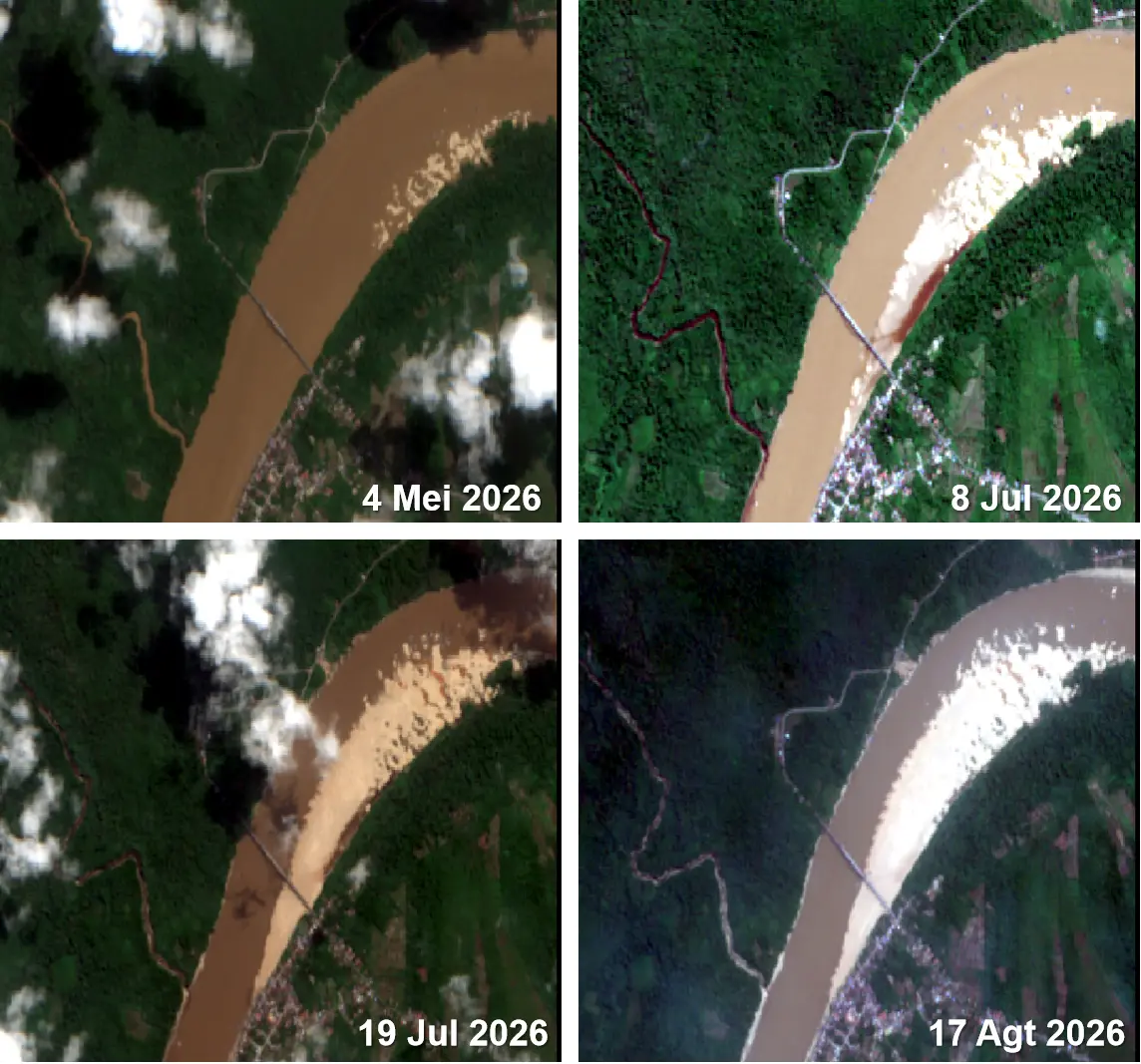
The Barito River near the Kalahien Bridge, South Barito Regency, Central Kalimantan, has shown clear changes throughout the 2026 dry season. Falling water levels have exposed the sandy riverbed and sandbars beneath. The shift became most visible in mid-August, when the water surface appeared far narrower than it had just months before.
The changes can be traced through Sentinel-2 satellite imagery captured at four points in time: 4 May, 8 July, 19 July, and 17 August 2026. In early May, the Barito near Kalahien still appeared relatively wide. By July, sandy areas along the banks and inside the river bends had grown noticeably. The shift was more pronounced on 19 July, and by 17 August exposed sandbars dominated several stretches of the river.
Hydrologically, this is closely tied to reduced water supply during the dry period. When rainfall drops over an extended stretch, runoff from the catchment areas feeding the Barito declines with it. River discharge falls, and water levels drop. In shallower sections with sandy deposits, that drop is enough to expose the riverbed. What we are seeing, then, is not a fully dried-out river — rather, the active channel and water surface have contracted.
Satellite imagery offers a way to measure this change objectively. Using a water index such as the Modified Normalized Difference Water Index (MNDWI), open water can be separated from land and exposed riverbed. From a time series of images, it becomes possible to calculate the water surface area, the extent of exposed riverbed, and how the active channel width has shifted. A pattern that initially reads only as a change in color and shape on a satellite image can be turned into quantitative information.
The Barito at Kalahien shows how remote sensing data can help us understand environmental dynamics more quickly and comprehensively. Through Piksel, a sequence of satellite images can be used to compare conditions across time and reveal changes that would be difficult to detect from a single vantage point.